SpaceSim is a high-performance, real-time 2D gravity simulation built to explore the complexities of the N-body problem. Developed in C++ using modern Object-Oriented Design (OOD) principles, the project simulates thousands of celestial bodies interacting under mutual gravitational attraction at interactive speeds.
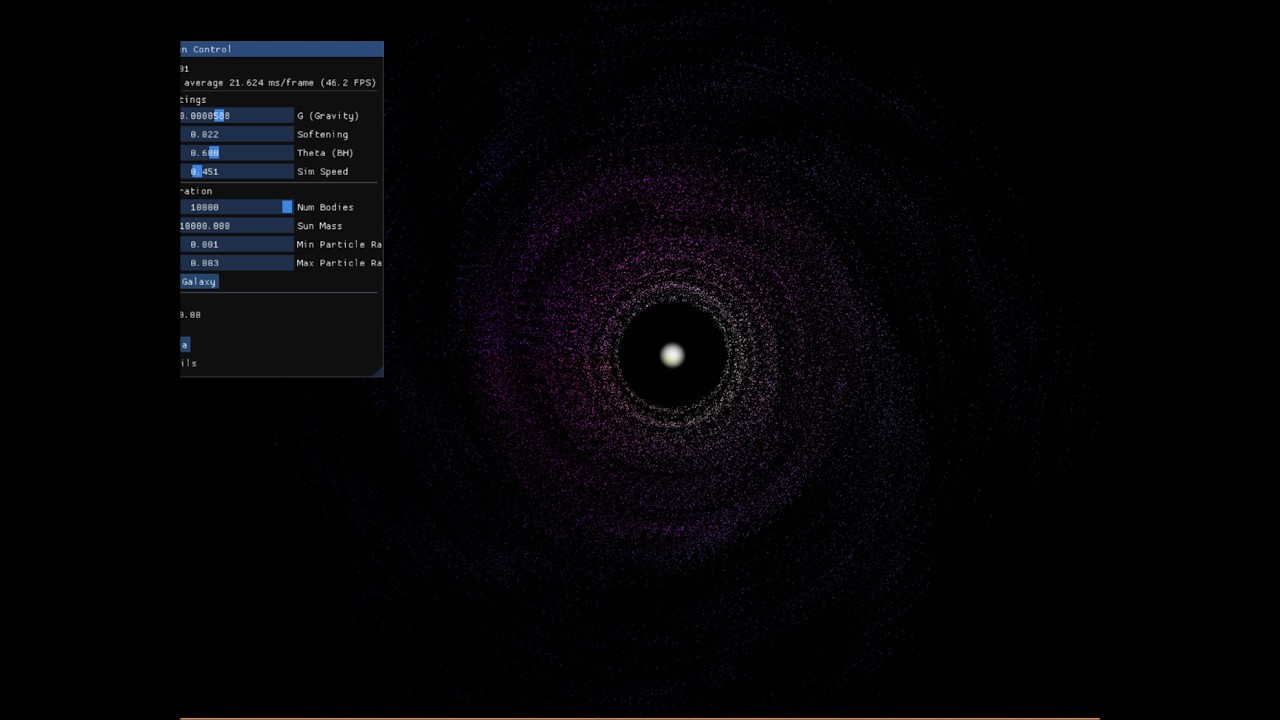
- Real-Time Performance: Handles upwards of 10,000 simultaneous bodies at a stable 60+ FPS.
-
Optimized Physics: Utilizes the Barnes-Hut algorithm to reduce computational complexity from
$O(N^2)$ to$O(N \log N)$ . - Hardware Acceleration: Leverages OpenGL 3.3 and instanced rendering to draw thousands of entities in a single GPU call.
- Stable Integration: Employs a semi-implicit Symplectic Euler integrator and gravitational softening to ensure physical stability.
- Parallel Computing: Uses OpenMP to distribute physics calculations across multiple CPU cores.
- Cross-Platform: Built with CMake, offering standalone, zero-dependency binaries for both Linux and Windows.
The system is designed with a decoupled architecture to separate physics logic from rendering:
- Universe Manager: The central orchestrator that manages the application lifecycle, boundary detection, and quadtree reconstruction.
- SimObject Hierarchy: A polymorphic base class for celestial entities (Stars, Planets) that handles physical states like position, velocity, and mass.
- Quadtree: A recursive spatial partitioning structure used to optimize force calculations.
- Renderer: A dedicated OpenGL pipeline using custom GLSL shaders for procedural "misty" galaxy aesthetics.
- Language: C++20
- Graphics: OpenGL 3.3 (Core Profile), GLFW, GLAD
- Math: GLM (OpenGL Mathematics)
- UI: Dear ImGui for real-time parameter tuning
- Build System: CMake
- Parallelism: OpenMP
The simulation solves the N-body problem numerically. Key highlights include:
- Numerical Stability: Uses gravitational softening to prevent mathematical singularities when bodies get too close.
- Procedural Aesthetics: Visuals are enhanced with fragment shaders that create radial glows and distance-based color gradients.
- Dynamic Tree Rebuilding: The Quadtree is rebuilt every frame to accommodate the moving bodies across the spatial domain.